
Java 8’s forEach Method with Practical Examples
In the world of Java programming, the introduction of the forEach method with Java 8 marked a significant stride towards streamlined and efficient iteration over collections, adding a powerful tool to a developer’s arsenal.
This method offers a seamless experience for iterating through elements in maps, lists, sets, or streams, demonstrating flexibility and convenience. In this exhaustive guide, readers will be acquainted with the nuances of this method, enriched with practical examples to facilitate a hands-on understanding.
Unleashing the Potential of the forEach Method
In the realms of iterative processes within the Java programming language, the forEach function emerges as a potent alternative to traditional loops, marking its inception in Java 8. Serving the foundational purpose of iterating through elements within data collections, this function extends its utility to maps, lists, sets, and streams, enhancing code readability and efficiency.
The syntax underscoring the forEach function is encapsulated as follows:
void forEach(Consumer<? super T> action)
As articulated in the Javadoc, this function is crafted to execute a specified action for each element within an iterable, marking its completion upon processing all elements or encountering an exception. The ‘action’ is embodied within a class adhering to the consumer interface protocols and is subsequently relayed as an argument to the forEach function.
The Consumer Interface Dissected
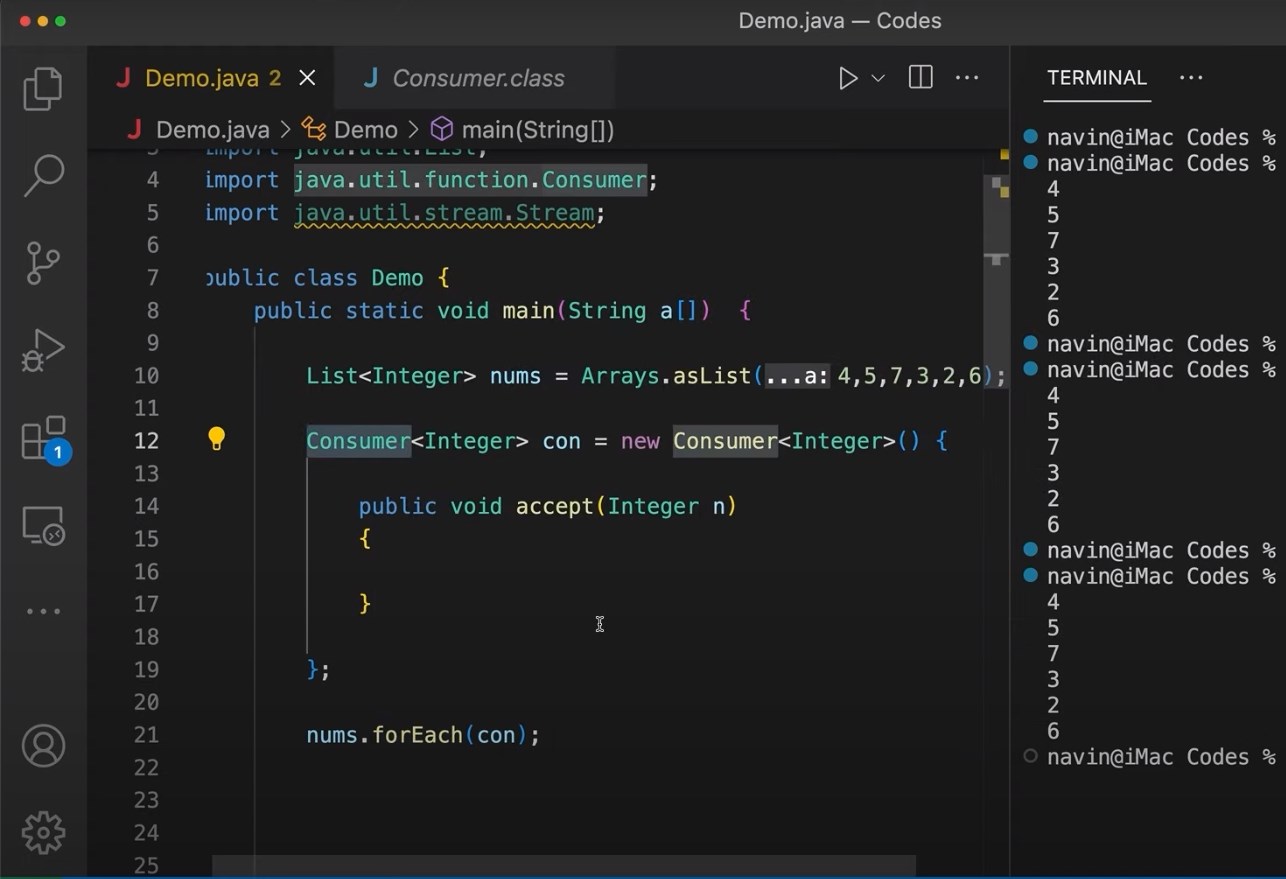
Characterized as a functional interface, the consumer interface is defined with a solitary abstract method, epitomizing an operation accepting an input argument yet yielding no output. Its definition is scripted as follows:
@FunctionalInterface public interface Consumer<T> { void accept(T t); }
Within this structure, actions like printing a string can be adeptly relayed to the forEach function as arguments, fostering operational efficiency and streamlined code structures.
Implementation Techniques
The forEach method in Java can be employed through diverse approaches, each catering to varied coding preferences and requirements:
- Anonymous Consumer Implementation:
- The consumer interface can be instantiated through an anonymous class, and this instantiation can subsequently be channelized as an argument to the forEach function.
- Lambda Expression Integration:
- Java 8’s introduction of functional interfaces paves the path for the integration of lambda expressions. This facilitates a concise and efficient alternative to traditional anonymous class implementations.
- Method Reference Application:
- In scenarios where existing methods are compatible with the forEach function’s requirements, method references offer a simplified syntax for streamlined code implementation.
Practical Engagements
The forEach method finds its profound applications across varied collection types, including queues, lists, and sets. Its universal syntax and implementation ease render it a preferred choice among Java developers. Below is an illustration of its application across distinct collection types:
List<String> days = Arrays.asList(“Monday”, “Tuesday”, “Wednesday”, “Thursday”, “Friday”, “Saturday”, “Sunday”); days.forEach(System.out::println);
Similar syntax and implementation ease are replicated across sets and queues, underscoring the forEach method’s versatility and universal appeal.
The forEach method, ingrained in Java 8, exemplifies a blend of efficiency, simplicity, and versatility. Its capacity to iterate over varied collection types with streamlined syntax catapults it to prominence among developers seeking to balance code efficiency with readability.
Navigating Map Iteration with Java 8 forEach
One of the novel features in Java 8 is the enhanced iteration capability, especially over complex structures like maps. Although a map isn’t inherently iterable, Java 8 presents programmers with refined techniques to navigate through it seamlessly.
Utilizing Map’s forEach
The BiConsumer interface, introduced in Java 8, elevates the ease of iterating maps using the forEach function. This interface allows developers to apply actions concurrently to both keys and values within a map. Here is an elucidated illustration of employing this technique:
import java.util.HashMap; import java.util.Map; public class MapIterationExample { public static void main(String[] args) { Map<Integer, String> weekdays = new HashMap<>(); weekdays.put(1, “Monday”); weekdays.put(2, “Tuesday”); weekdays.put(3, “Wednesday”); weekdays.put(4, “Thursday”); weekdays.put(5, “Friday”); weekdays.put(6, “Saturday”); weekdays.put(7, “Sunday”); weekdays.forEach((integer, s) -> System.out.println(integer + ” : ” + s)); weekdays.forEach((integer, s) -> { if (integer == 5) { System.out.println(“The 5th day is ” + s); } }); weekdays.forEach((integer, s) -> { if (“Wednesday”.equals(s)) { System.out.println(“Wednesday is the ” + integer + ” day of the week”); } }); } }
In this snippet, the BiConsumer interface simplifies map iteration, making code more readable and concise.
Iterating via EntrySet
Another strategy encompasses iterating the EntrySet of the map using forEach. Given that map entries are stored within an “EntrySet,” iterating this set becomes intuitive and straightforward. Here’s a demonstration:
weekdays.entrySet().forEach(entry -> System.out.println(entry.getKey() + ” – ” + entry.getValue()));
Stream Iteration Insights
The advent of streams in Java 8 marked a pivotal transition in handling collections of objects. Notably, a stream isn’t a data structure but a conduit for processing object collections. It sources data from collections or I/O channels and consecutively applies operations.
Iterating Streams with forEach
Streams, endowed with the forEach function, facilitate an efficient mechanism to iterate elements. Below is an illustrative example:
import java.util.ArrayList; import java.util.List; public class StreamIteration { public static void main(String[] args) { List<String> weekdays = new ArrayList<>(); weekdays.add(“Monday”); weekdays.add(“Tuesday”); weekdays.add(“Wednesday”); weekdays.add(“Thursday”); weekdays.add(“Friday”); weekdays.add(“Saturday”); weekdays.add(“Sunday”); weekdays.stream() .filter(day -> day.startsWith(“W”)) .forEach(System.out::println); } }
In this example, a stream is created from a list, filtered to retain elements commencing with “W,” and finally, iterated using forEach.
Detailed Analysis
The precision and efficiency of Java 8’s forEach have harmonized the complexity of iterations, especially over intricate structures like maps and streams. The integration of the BiConsumer interface and the streamlined syntax has not only bolstered code efficiency but also enhanced readability.
Key Takeaways:
- BiConsumer facilitates concurrent actions on map keys and values;
- EntrySet iteration offers an alternative for map navigation;
- Streams, coupled with forEach, streamline collection processing.
Future Outlook
As Java continues to evolve, the anticipation is the refinement of these features, rendering programming not just about solving complex problems but also with elegance and efficiency. The forEach method exemplifies this trajectory, offering insights into the future of iterative programming in Java.
ForEach in Contrast with For-Loop
The Java forEach function has been distinguished for its efficiency, especially when juxtaposed with the conventional for-loop. While a basic for-loop presents challenges in iterating through collections, lists, or maps, the forEach function emerges as a resourceful alternative.
Internal vs. External Iteration
The distinction becomes even more pronounced when assessing the enhanced for-loop and forEach function. Their primary separation hinges on the types of iterators they deploy. The enhanced for-loop utilizes an external iterator, whereas forEach incorporates an internal iterator.
Internal Iterators:
- Managed Iteration: Internal iterators supervise the iteration processes, relieving developers of meticulous iteration management;
- Conciseness: They advocate for brevity, requiring minimal lines of code and offering straightforward implementation.
External Iterators:
- Explicit Management: With external iterators, developers exert direct control over the iteration’s progression, invoking every successive element explicitly;
- Flexibility and Complexity: Although offering flexibility, they encapsulate a level of complexity and are potentially error-prone.
Advancements in Collection Iteration
In the realm of programming, continuous refinement and evolution of techniques is paramount. The introduction of forEach in Java marked a significant stride in optimizing the way collections are iterated.
- Simplicity and Efficiency: The method underscores an easy yet efficient way to traverse through collections, rendering code that is both clean and understandable;
- Internal Management: It eliminates the need for explicit handling of iteration processes, thereby reducing the possibility of errors.
Key Features:
- Streamlines code by automating iteration processes;
- Encourages functional programming principles;
- Facilitates concurrent processing, enhancing performance.
Integration of Lambda Expressions
The incorporation of lambda expressions with forEach has not just simplified the syntax but also enhanced readability. Programmers can now execute actions on elements within a collection seamlessly, marking a departure from the verbose syntax of the past.
- Clarity: Eliminates the boilerplate code, fostering clear and concise code;
- Functional Approach: Augments functional programming, allowing actions to be executed directly on elements.
Reflecting on ForEach’s Efficacy
The exploration of the forEach method unveils its intrinsic capability to revolutionize collection iteration. The combination of simplicity, efficiency, and the facilitation of a functional programming paradigm underscores its prominence.
Every technology and every method comes with its distinct set of attributes and shortcomings. In the context of the forEach method, while its simplicity and efficiency are undeniable, considerations regarding its applicability in diverse scenarios, performance implications, and compatibility with existing systems and practices are crucial.
The forEach method isn’t just a technical enhancement; it is emblematic of the evolution of programming – a stride towards a domain where code is not just about functionality but also about readability, manageability, and efficiency.
Conclusion
Throughout this discourse, the exploration of the forEach method within Java has been extensive. We’ve delved into its implementation across various data structures, distinguishing it from traditional iteration mechanisms, and underscoring its integration with functional programming constructs like lambda expressions.
Key Takeaways:
- Flexibility: The forEach method’s adaptability across diverse data structures exemplifies its versatility;
- Efficiency: With reduced boilerplate code and enhanced readability, forEach optimizes both the development and maintenance phases of software engineering;
- Functional Paradigm: The integration of functional programming elements augments both the performance and readability of code.
In the ever-evolving landscape of software development, where adaptability and efficiency are pivotal, methods like forEach are not just conveniences but necessities. They embody the fusion of theoretical programming constructs with practical software development needs, indicative of an era where programming is as much an art as it is a science.
Adopting such advanced techniques underscores a commitment to quality, efficiency, and the continuous pursuit of excellence in software development. The forEach method, in its essence, is not just a tool but a reflection of the evolving ethos of programming, where every line of code is a blend of efficiency, functionality, and artistry.
No Comments
Sorry, the comment form is closed at this time.